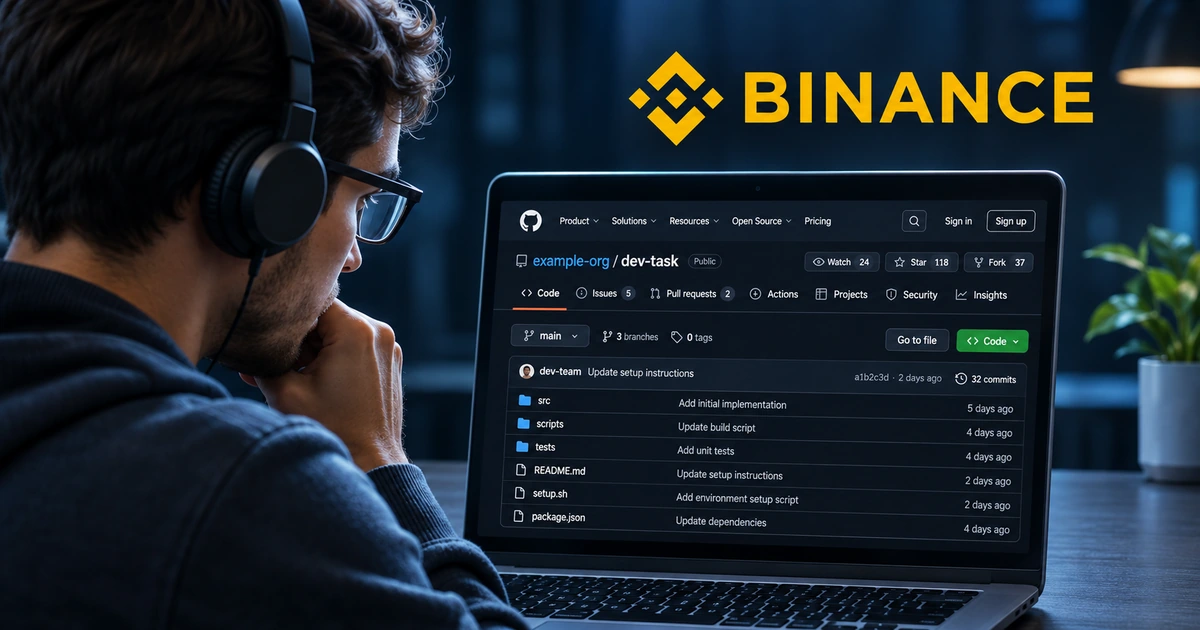
A recruiter. Two interviews. A coding assignment. What looked like a professional opportunity became one part of a months-long cyberattack that ultimately affected approximately $6.34 billion in digital assets.
It Began With an Ordinary Job Opportunity
Imagine you're a software engineer working for a major cryptocurrency company.
One day, someone contacts you through a legitimate recruitment platform.
The opportunity sounds interesting.
The recruiter has a professional profile. The job description looks credible. The position appears relevant to your experience.
You're invited to an initial interview.
A person claiming to represent the company's HR department speaks with you on a live video call.
They even share a social media profile containing personal photographs and videos.
Nothing immediately suggests that you're dealing with criminals.
You pass the first interview.
A second meeting follows, this time with someone who claims to be the CEO of the prospective employer.
Near the end, you're asked to complete a practical programming assignment.
There's a repository to download and some code to set up.
For a developer, that sounds perfectly normal.
But this is where the situation changes.
The repository contains malicious code that executes during the setup process.
Instead of simply testing your programming skills, the assignment gives attackers a foothold on your computer.
This is not a fictional scenario. It is one of the attack paths described by Binance following its October 29, 2026 security incident.
According to Binance's preliminary investigation, a software engineer was targeted through a fraudulent recruitment process involving a fictitious company.
The malicious assignment helped attackers compromise the engineer's work computer.
But the attackers did not stop there.
Over the following weeks, they moved deeper into the company's environment.
By October 29, the attack had reached cryptocurrency wallet-signing infrastructure.
Approximately $6.34 billion in digital assets were affected.
Source: Binance — Initial Findings and Response Update, November 3, 2026
What Happened to Binance?
On October 29, 2026, Binance experienced one of the largest cryptocurrency security incidents ever reported.
The attack involved unauthorized transfers from the exchange's hot wallets across several blockchain networks.
A hot wallet is a cryptocurrency wallet connected to online systems that enable operational activities such as transfers and withdrawals.
Because these wallets interact with active infrastructure, their security depends on more than the secrecy of private keys.
Access permissions, transaction-signing systems, employee devices and internal operational controls also matter.
According to Binance's initial report:
- Approximately $6.34 billion in digital assets were affected.
- Approximately $2.85 billion had been frozen or intercepted as of November 3, subject to reconciliation and market volatility.
- The company said it would absorb the financial impact instead of passing the loss to customers.
- By November 4, Binance reported replenishing approximately 98% of the affected token assets using its resources.
These figures describe different things.
Frozen assets are not necessarily recovered assets.
Replenishing reserves does not mean the attackers returned the stolen cryptocurrency.
And a company's commitment to cover losses should not be confused with an independently completed assessment of every affected account.
Binance has said its investigation remains ongoing and that independent security experts will review its findings.
Source: Binance — Recovery Update #7, November 4, 2026
The incident also received attention from US law enforcement.
On October 31, 2026, the Federal Bureau of Investigation attributed the theft to the Democratic People's Republic of Korea, using the designation TraderTraitor for the malicious cyber activity.
The FBI's statement is an official attribution. It does not mean every technical detail of the attack has been publicly established.
Source: FBI — North Korea Responsible for $6 Billion+ Binance Attack
The Attack Was Built Over Months
The public timeline reveals why this case is more complicated than a single malicious link.
June 2026: A Compromised Developer Tool
According to Binance, one Wallet DevOps engineer downloaded a tampered Homebrew installation while attempting to install a popular AI coding tool.
The software had been encountered through a search engine.
Binance's security team detected suspicious activity, replaced the affected device and rotated associated credentials.
Those were important defensive actions.
However, the incident exposed information about the engineer's role and colleagues working on wallet infrastructure.
This detail matters because attacks do not always succeed immediately.
An unsuccessful or interrupted compromise can still disclose information that helps an attacker choose future targets.
September 2026: The Fake Recruitment Process
Another software engineer was approached through a legitimate job platform.
The attacker presented themselves as a project director.
A first interview with a purported HR representative took place by video.
A second interview was conducted through a social messaging application with a person claiming to be the CEO of a company.
The company was fictitious.
During the second interview, the engineer was asked to download a coding assignment.
The repository contained malicious code that ran during setup.
According to Binance, the malware used obfuscation and replaced a legitimate component of a developer tool with a malicious version.
It was not detected by endpoint security protection at the time.
A seemingly routine recruitment task had become a route into a corporate workstation.
October 20: Movement Through Internal Systems
Binance reported that the attackers used the compromised engineer's computer and an internal AI tool to reach other employees working on wallet infrastructure.
They also discovered a container deployment permission token on another engineer's machine.
This expanded their ability to interact with internal systems.
An important distinction is necessary here:
The report does not establish that artificial intelligence independently planned or executed the theft.
Rather, it describes attackers exploiting access to an internal AI-enabled tool as part of their movement through the organization.
The weakness was not simply the presence of AI.
It involved compromised endpoints, access relationships, credentials and operational permissions.
October 29: The Wallet Infrastructure Was Reached
According to Binance, attackers accessed another engineer's computer, used previously obtained credentials and deployed a container carrying a malicious script.
They reached the internal wallet-signing service.
Shortly after 20:05 UTC, unauthorized cryptocurrency transfers began.
Between 20:05 and 20:09 UTC, five Binance hot wallets transferred approximately 233.46 million XRP to an attacker-controlled address.
Other affected assets included SOL, OP, BTC and ETH.
Binance detected unusual transfers and began its emergency response.
But stopping the attack proved more difficult than simply suspending withdrawals.
Why Stopping Withdrawals Was Not Enough
One of the most technically important aspects of the incident involves Ethereum's EIP-7702 mechanism.
EIP-7702 enables an externally owned Ethereum account to delegate execution to smart-contract code.
It is a legitimate feature designed to support more flexible account functionality.
However, its security depends on what is authorized and who controls the delegated code.
According to Binance, the attackers used unauthorized access to its signing infrastructure to establish malicious delegation permissions involving an Ethereum hot wallet.
Those permissions enabled attacker-controlled code to perform certain operations independently of the exchange's normal withdrawal infrastructure.
This created a difficult containment problem.
Even after Binance suspended withdrawals, previously established on-chain permissions could still enable unauthorized asset movements.
The company reported that its use of Multi-Party Computation, or MPC, added complexity because there was no single private key available for an immediate revocation operation.
Binance eventually executed a transaction clearing the malicious delegation at 00:10 UTC on October 30.
The official EIP-7702 specification confirms that delegation can be cleared by authorizing the zero address.
The lesson is not that EIP-7702 is inherently malicious or that Ethereum itself was broken.
The incident illustrates what can happen when attackers gain access to systems authorized to make security-critical decisions.
A compromised signing operation can create consequences that continue beyond an ordinary application's shutdown.
Technical reference: Ethereum — EIP-7702 Specification
The Most Important Warning: A Real Interview Can Still Be a Trap
The fake recruitment stage is relevant far beyond cryptocurrency exchanges.
Software developers routinely receive coding assignments during hiring processes.
A legitimate employer may ask candidates to demonstrate their skills, review code, build a small application or solve a technical challenge.
Attackers exploit the familiarity of these practices.
A convincing recruitment operation might include multiple interviews, professional-looking profiles, realistic job descriptions and a repository that appears to contain a normal development project.
The objective is to persuade someone to execute untrusted code.
The dangerous moment is not necessarily when the candidate clicks a link.
It may happen when the project is installed, when a dependency runs a script, or when a development tool executes something the candidate did not recognize.
This is why the instruction "Don't click suspicious links" is not enough for developers.
Even legitimate development workflows can execute code that a user has not personally inspected.
Warning Signs During a Technical Interview
Be especially cautious when a recruiter or interviewer:
- Moves the conversation to an unfamiliar messaging platform without a clear professional reason.
- Asks you to install a specific application from an unusual download location.
- Sends a repository that must be executed rather than merely reviewed.
- Requests that you run code on your employer's computer.
- Asks you to disable security software to complete an assignment.
- Pressures you to execute commands immediately during a call.
- Refuses reasonable alternatives, such as a written code review or a controlled assessment environment.
None of these signs alone proves malicious intent.
But an unexpected request to execute third-party code deserves careful verification, especially when the device contains corporate credentials or access to sensitive infrastructure.
How Developers Can Protect Themselves
A practical safety process can reduce the risk of a recruitment-based attack.
1. Verify the Employer Independently
Do not rely exclusively on the identity presented in a recruitment message.
Find the company's official website yourself.
Check whether the position exists on its careers page.
If necessary, contact the company through an independently verified address to confirm that the recruitment process is genuine.
A professional profile, a video call or a convincing company website is not sufficient evidence by itself.
2. Keep Interview Assignments Away From Corporate Systems
Do not execute unfamiliar interview projects on a work computer that has access to production systems, internal repositories, deployment credentials or company secrets.
Use a dedicated assessment environment approved by your organization's security policy.
Isolation reduces exposure, but it is not an absolute guarantee against malicious code.
The environment must be appropriately configured, with no unnecessary access to sensitive files, credentials or networks.
3. Examine the Project Before Executing It
Look at the repository's contents and expected setup process.
Identify whether installation or build steps execute scripts, download additional components or request unusual permissions.
If you do not understand what the code will do, do not run it.
Ask the recruiter for clarification or an alternative assessment method.
4. Treat Unexpected Software Downloads as a Separate Risk
A coding assignment should not automatically require you to install a new video conferencing client, browser extension, command-line utility or package manager from an unknown source.
Use independently verified official distribution channels.
Avoid commands copied directly from recruitment chats without understanding and validating them.
5. Report Suspicious Requests Promptly
If a recruiter asks you to run an unusual program, inform your employer's security team if you are using a corporate device or if your work credentials could be exposed.
Reporting a suspicious request is useful even if you did not execute the file.
Early reporting may help identify similar attempts targeting colleagues.
What If You Already Ran a Suspicious Coding Assignment?
The correct response depends on the device and the actions performed.
| Situation | Recommended response |
|---|---|
| You downloaded a repository but did not execute it | Do not run it. Preserve basic details for a security report and ask for an assessment. |
| You executed code on a personal computer | Stop sensitive activity on the device and seek technical help to determine whether it was compromised. |
| You executed code on a work computer | Immediately contact your employer's security or incident response team. |
| The device had access to corporate credentials | Ask the security team to review sessions, tokens, secrets and relevant access logs. |
| The device had cryptocurrency wallet access | Secure the wallet environment and seek expert guidance before signing additional transactions. |
| You provided seed phrases or private keys | Treat those secrets as compromised and seek trusted assistance with appropriate wallet recovery or migration procedures. |
If you suspect the device is actively compromised, disconnect it from the network where appropriate and follow your organization's incident response procedures.
Do not attempt to remove every suspicious file before reporting the incident. That could destroy information needed for forensic analysis.
Changing a password alone may not revoke existing access tokens or sessions.
For developer environments, access may also depend on SSH keys, cloud credentials, deployment tokens and connected applications.
Organizations should investigate the full scope of potential exposure rather than treating the incident as an isolated password problem.
What Can Blockchain Investigators Actually See?
The Binance incident also illustrates why blockchain investigations require careful interpretation.
Public blockchains provide records of transactions, addresses, assets, timestamps and interactions with smart contracts.
Investigators can use these records to reconstruct how digital assets moved.
For example, they may examine:
- Which addresses received funds from the affected wallets.
- When specific transfers occurred.
- How stolen assets moved across supported networks.
- Whether assets were exchanged through decentralized platforms.
- Whether multiple addresses display similar transactional behavior.
- Which addresses have been identified in official law-enforcement or threat-intelligence alerts.
However, the blockchain does not automatically reveal the real-world identity of every person controlling an address.
A cluster of connected wallets is an investigative lead, not conclusive proof that one individual operates them all.
What Investigators Found in This Case
In its October 31 statement, the FBI published blockchain addresses associated with the theft and urged relevant cryptocurrency service providers to help disrupt further laundering.
The FBI reported observing attackers convert stolen assets primarily into ETH, with further movement through decentralized finance and swap services anticipated.
Blockchain intelligence firm Chainalysis also reported tracing stolen funds through numerous transactions and identifying patterns consistent with automated laundering activity.
These observations can support transaction tracing and risk assessment.
But investigators still need to distinguish direct blockchain evidence from analytical attribution.
Source: FBI — Official TraderTraitor Alert
Source: Chainalysis — Binance Hack: Tracing the North Korea Link
Why Digital Evidence Must Be Connected Carefully
Consider the different kinds of evidence involved in this incident.
One set concerns recruitment: job postings, recruiter profiles, communication accounts and messages.
Another concerns malware: repositories, downloaded files, execution events and suspicious network activity.
A third concerns internal systems: compromised endpoints, credentials, deployment activity and wallet-signing operations.
Finally, the blockchain provides transaction records and potentially traceable fund movements.
Investigators may be able to establish relationships across these sources.
But each relationship must be evaluated according to the available evidence.
For example, two fraudulent recruiter profiles might use the same website or contact address.
That coincidence is worth investigating.
It does not automatically prove that both profiles belong to the same person.
Similarly, several blockchain addresses receiving related funds might be connected through a common service, intermediary or automated process.
The correct approach is to preserve the source of every observation, examine its reliability and avoid treating duplicated information as independent corroboration.
This is especially important when reports from different researchers may repeat the same underlying claim.
A convincing investigation is not the one with the most connections. It is the one that can explain what each connection actually proves.
What This Case Teaches Us About OSINT
Open-source intelligence can contribute to the investigation of sophisticated fraud and intrusion campaigns.
Public professional profiles, domains, online identities, suspicious recruitment advertisements and blockchain transactions may provide valuable clues.
But OSINT has limits.
Public information alone does not establish how an attacker accessed a private system.
Internal logs, device forensics, access-control records and cooperation with affected organizations may be required.
In a case like Binance, investigators should separate the evidence into distinct layers:
Recruitment infrastructure: Which publicly observable profiles, websites and contact channels were used?
Technical infrastructure: Which domains and externally visible services are associated with identified malicious activity?
Identity relationships: Are connections supported by genuinely independent sources, or are different reports repeating the same information?
Blockchain activity: Which transactions can be verified directly, and which wallet relationships are analytical assessments?
Attribution: Which conclusions come from technical evidence, and which rely on statements from investigators or law enforcement?
This approach helps avoid a common investigative mistake: turning an interesting coincidence into an unsupported accusation.
At Axon OSINT, we believe that responsible digital investigations should prioritize traceable evidence, source provenance and clearly explained analytical conclusions.
The purpose is not to draw as many connections as possible.
It is to understand which connections can actually be supported.
What Should Binance Users Do?
The incident may also create opportunities for secondary scams.
Whenever a major cryptocurrency platform suffers a security breach, criminals may attempt to exploit confusion by impersonating customer support, recovery services or company representatives.
A message might claim:
"Your Binance funds are at immediate risk."
"Complete this emergency wallet verification."
"Transfer your assets to a protected address."
"Pay a recovery fee to unlock your compensation."
These are illustrative examples of possible follow-up scams, not verified messages from the October 29 attackers.
Protect Your Account
If you use Binance or another cryptocurrency exchange:
- Open the platform's official application or website yourself rather than following unsolicited links.
- Review security notifications and account activity through the authenticated platform.
- Use strong, unique passwords and available multifactor authentication or passkeys.
- Check connected devices, authorized applications and API keys where applicable.
- Contact official support if you see activity you do not recognize.
Never provide a seed phrase or private key to someone claiming to represent exchange support.
Never transfer funds to an unfamiliar wallet because a stranger says it is a safer place during an emergency.
If you use a self-custody wallet, examine any unexpected request to approve a transaction, token allowance or account delegation.
An unfamiliar signature request can create risks even when it does not look like an ordinary cryptocurrency transfer.
Check Official Incident Updates
Binance has stated that it will cover the financial impact of the October 29 theft.
That commitment should be checked through official company announcements.
There is no reason to trust a random person in a social media comment who claims to arrange special compensation.
Avoid sharing account details or documents with unofficial recovery agents.
If funds have already been transferred to a scammer, contact the relevant platform and report the matter promptly through official channels.
Do not assume that blockchain transactions can automatically be reversed.
Where to Get Help
If you suspect a compromised account, fraudulent recruitment approach or cryptocurrency theft, start with the affected service provider and, where relevant, your employer's security team.
If money has been stolen, report the incident to the appropriate authorities.
| Country | Official resource |
|---|---|
| Germany | Polizei Onlinewache — police reporting; BSI — cybersecurity guidance |
| France | Cybermalveillance.gouv.fr — help after cyber incidents; 17Cyber |
| Italy | Polizia di Stato — police assistance; CERT-AGID — cyber threat warnings |
| Spain | INCIBE — cybersecurity helpline, 017 |
| Poland | CERT Polska — report cyber incidents and phishing |
| United Kingdom | Report Fraud — reporting in England, Wales and Northern Ireland; Police Scotland for Scotland |
| Australia | Australian Cyber Security Centre — cyber incident reporting and recovery |
| United States | FBI Internet Crime Complaint Center — cybercrime reporting |
| Ukraine | Cyberpolice of Ukraine — cybercrime reports and official guidance |
These organizations offer different forms of support. Some provide guidance, while others accept incident reports or criminal complaints.
For a corporate security incident, use your organization's established incident response procedures before making changes that could affect evidence.
The Bigger Lesson: Trust Can Be Exploited at Every Stage
The most disturbing part of the Binance incident is not only the reported financial loss.
It is the way apparently ordinary professional interactions became part of a much larger attack.
A credible recruiter.
A live interview.
A programming assignment.
A compromised development environment.
Access to internal tools.
A stolen deployment token.
Unauthorized wallet operations.
Each stage created opportunities for the next.
No single public indicator tells the complete story.
The breach also demonstrates why cybersecurity cannot depend on one defensive layer.
A suspicious program may evade endpoint protection.
A compromised employee account may still appear legitimate.
A permission granted on-chain may continue to matter even when an ordinary service has been shut down.
And a blockchain transaction can establish that funds moved without necessarily proving who controlled every intermediary address.
For individuals, the practical lesson is to verify unexpected opportunities, protect sensitive devices and avoid executing untrusted code.
For organizations, it is to control privileges, monitor unusual behavior and prepare for incidents that cross multiple security boundaries.
For investigators, it is to connect evidence carefully without confusing correlation with proof.
The Binance case shows how an attack that ultimately moves billions in cryptocurrency can begin with something as familiar as a job interview.
That is why digital trust must be earned through verification, not assumed from appearances.
Sources and Further Reading
- Binance — 29 October 2026 Security Incident: Initial Findings and Response Update, November 3, 2026.
- Binance — Recovery Update #7: 98% of Stolen Assets Replenished, November 4, 2026.
- FBI — North Korea Responsible for $6 Billion+ Binance Attack, October 31, 2026.
- Reuters — Binance Hackers Used Fake Job Interview in $6.3 Billion Attack, November 3, 2026.
- Chainalysis — DPRK Hackers Perfected Their Fake Interview Playbook, November 3, 2026.
- Chainalysis — The $6.4 Billion Binance Hack: Tracing the North Korea Link, October 30, 2026.
- Ethereum Improvement Proposals — EIP-7702: Set Code for EOAs.
- FBI IC3 — North Korean IT Worker Threats to US Businesses.
Editorial note: This article reflects information publicly available as of November 8, 2026. Binance's investigation and independent review are ongoing. The incident timeline is primarily based on the company's preliminary disclosures. Attribution to North Korea is identified as the FBI's official assessment. Descriptions of potential secondary scams and recommended protective measures are general security guidance, not additional confirmed findings from the Binance investigation.
About Axon OSINT
Axon OSINT is a digital investigation and fraud intelligence platform focused on examining information, identifying relevant connections and supporting evidence-based analysis.
Through Fraud Education, we explain how digital threats work, what individuals and organizations can do to protect themselves, and why responsible investigations must distinguish observable evidence from assumptions.
Explore more at Axon OSINT — Fraud Education.